Start with the evidence.
The product vision begins with company filings and earnings transcripts. Every important claim should lead back to a passage you can inspect.
A clearer trading thesis starts with the source. We’re building an AI research workspace that connects market context to the documents behind it.
Built for curious traders.
Designed for independent judgment.
More context.
Less noise.
Q3 earnings transcript
Claim → evidence → contextResearch gets scattered across earnings calls, filings, notes, and charts. DocuAssist AI brings the evidence back into the conversation—so a confident summary never replaces a careful read.
The product vision begins with company filings and earnings transcripts. Every important claim should lead back to a passage you can inspect.
Separate reported facts from interpretation. Put the risks, caveats, and unanswered questions beside the thesis.
A research assistant for your process. No auto-trading, promises of returns, or black-box instructions to buy and sell.
A trading thesis needs more than a pattern on a screen. Our product direction combines document analysis, financial context, and a deliberate review of what could go wrong.
Is the growth as strong as it looks?
AI can miss context, misread a table, or produce an inaccurate summary. Our planned workflow keeps original passages available for review. The current interactive demo uses prepared examples; live AI, licensed data feeds, backtesting, and brokerage execution are not connected.
Our source workspace now uses selected facts from Microsoft’s FY2025 annual report. Choose a question, read the reviewed research note, and open the matching section of the original disclosure.
The source reader works today. Amazon Bedrock integration is prepared; live model responses require the founder’s AWS account connection. The workspace shows its actual connection state.
Three views from the working source reader.
Step through at your own pace.
These are screenshots of the current product, not a rendered concept or a video of live AI generation. The Bedrock connection remains pending.
Try the working source reader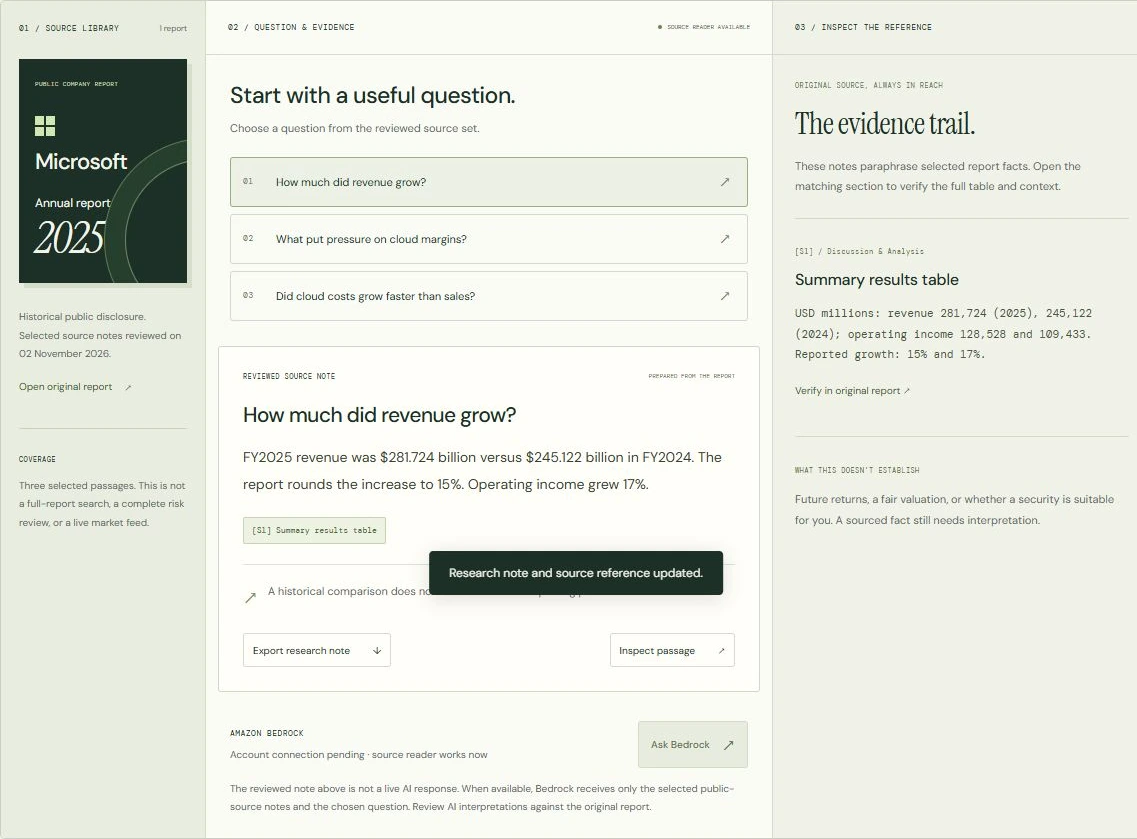
Take the research desk for a spin.
Choose a fictional company. Follow the evidence.
Enterprise software · Fictional company
In this example, subscription revenue grows while infrastructure spending weighs on operating margins.
Research, with reservations. Revenue growth alone does not establish profitability or future performance.
These excerpts are authored examples, not real company filings.
Questions to investigate before forming a conclusion.
This prototype is educational and does not provide personalized investment recommendations.
A preview of our product direction. This demo uses prepared summaries and fictional data; live AI analysis and document ingestion are planned.
We’re developing a subscription research workspace. The first job is to make source review useful enough to become part of a trader’s regular process.
People researching public companies who need to connect a thesis to company disclosures, maintain their notes, and revisit assumptions.
Reports, transcripts, chart tabs, and personal notes live in different places. We want to make a question’s supporting evidence easier to inspect and retain.
Public examples remain free. We plan individual research subscriptions and a shared workspace tier for small teams. No paid plan or checkout is available today.
The planned first step is founder-led workflow interviews and small pilots, measuring source usefulness and repeat research sessions before expanding features.
Current stage: prototype. Public source reader available. Customer acquisition, pricing tests, and paid subscriptions are planned; no customer, revenue, or traction figures are claimed.
Discuss a pilot ↗Our proposed use of AWS is specific: evaluate source-grounded answers, build document processing, and learn what a small research pilot costs to operate.
Public source notes
and original references
Fixed research question
and selected evidence
Bounded generation
with source identifiers
Evaluate answers to report questions using selected evidence and explicit source IDs. Track reference integrity, unsupported-answer behavior, latency, and token usage.
Planned storage for permitted source documents, versioned extraction output, and report manifests. Define access and retention rules before accepting private files.
Planned document-processing jobs for text extraction and source-location mapping. The current website API runs on Vercel; no Lambda workload is deployed yet.
Planned operational visibility, failure monitoring, and spending alerts for the pilot. Establish durable request quotas and cost controls before broader AI access.
Connect the founder’s AWS account, run a bounded report-question evaluation, and record source-reference quality and per-answer usage.
Acceptance: inspect every cited source.Trial public-report storage and text extraction, preserving document versions and a path back to the original section.
Acceptance: reproducible source locations.Review observed latency, inference and processing usage, failure modes, and access controls before inviting a wider pilot.
Acceptance: documented limits and costs.The website is hosted on Vercel. Its public source reader is available now. AWS role configuration is required for live Bedrock responses; storage, extraction, monitoring, and budget resources above are planned. AWS credits and approval are not guaranteed.
A focused workspace for independent traders and small research teams who want to understand the business behind a ticker.
Help shape the product
Company reports, earnings transcripts, and your own research notes, organized around a company.
Explore a document with AI assistance, with source references and uncertainty kept in view.
Review evidence, challenge assumptions, and export a short research brief. Try the example above.
DocuAssist AI was founded by Ranjan Mallick on 5 October 2026 in Kolkata. Our focus is a document-first research product: helping traders organize evidence and ask more useful questions.
We’re at the prototype stage. The next chapter is testing the workflow with early users, then building document ingestion and source-linked AI analysis.
Talk directly to the founderFounder · DocuAssist AI
Founder information provided by Ranjan Mallick. For business or identity verification enquiries, contact the founder directly.
Explore sample companies, inspect source notes, and export a brief.
Document ingestion and AI-assisted answers grounded in source passages.
Saved research, licensed market context, and collaboration for small teams.
The source reader and Bedrock adapter are implemented; live AI requires the founder’s AWS account connection. S3 document storage, Lambda processing, CloudWatch monitoring, and budget controls are planned. See the detailed AWS development plan above.
This website is hosted on Vercel. No AWS partnership, credits approval, or active AWS workload is claimed while account connection is pending.
You can use the real-report source reader and the fictional design sandbox now. Live AI connection status is shown in the source workspace. Document ingestion and the broader production product remain in development.
The design sandbox uses fictional data and prepared summaries. The separate source workspace uses selected facts from a real annual report and shows whether Amazon Bedrock is connected. Reviewed notes are clearly distinguished from AI interpretations. No live price feed, private upload, or brokerage connection is active.
The product direction is document research and evidence review. It does not execute trades or promise returns. You remain responsible for your research and investment decisions.
Public examples and the source reader are free. Individual subscriptions and a small-team workspace are planned; prices and paid plans have not been launched.
Email Ranjan Mallick at ranjanmallick@docuassistai.online. Founder details on this website are self-reported; there is no independent verification badge or claimed certification.
Have a workflow that needs a second look?
We’d like to hear how you do your research.